Gold Price in Pakistan Today
Looking for today’s gold price in Pakistan? Get the latest rates for 24K, 22K, and 18K gold as of July 8, 2026, and understand the factors driving market trends. Watching the gold market in Pakistan is like tracking a high-stakes weather system; just when you think you’ve got the pattern down, a shift in global currents changes everything. As of July 8, 2026, the local bullion market is seeing a cooling trend, providing a brief moment of reflection for investors and buyers alike. If you are keeping a close eye on your jewelry investments or planning to buy gold for an upcoming wedding, understanding these daily fluctuations is more than just about numbers—it’s about safeguarding your wealth in a volatile economy.
Also read: BISP 14500 Online Check By CNIC 2026 | New Payment Update
Current Gold Rates in Pakistan: What You Need to Know
The price of gold in Pakistan is not determined in a vacuum. It is a synchronized dance between the international bullion market and the local strength of the Pakistani Rupee (PKR).
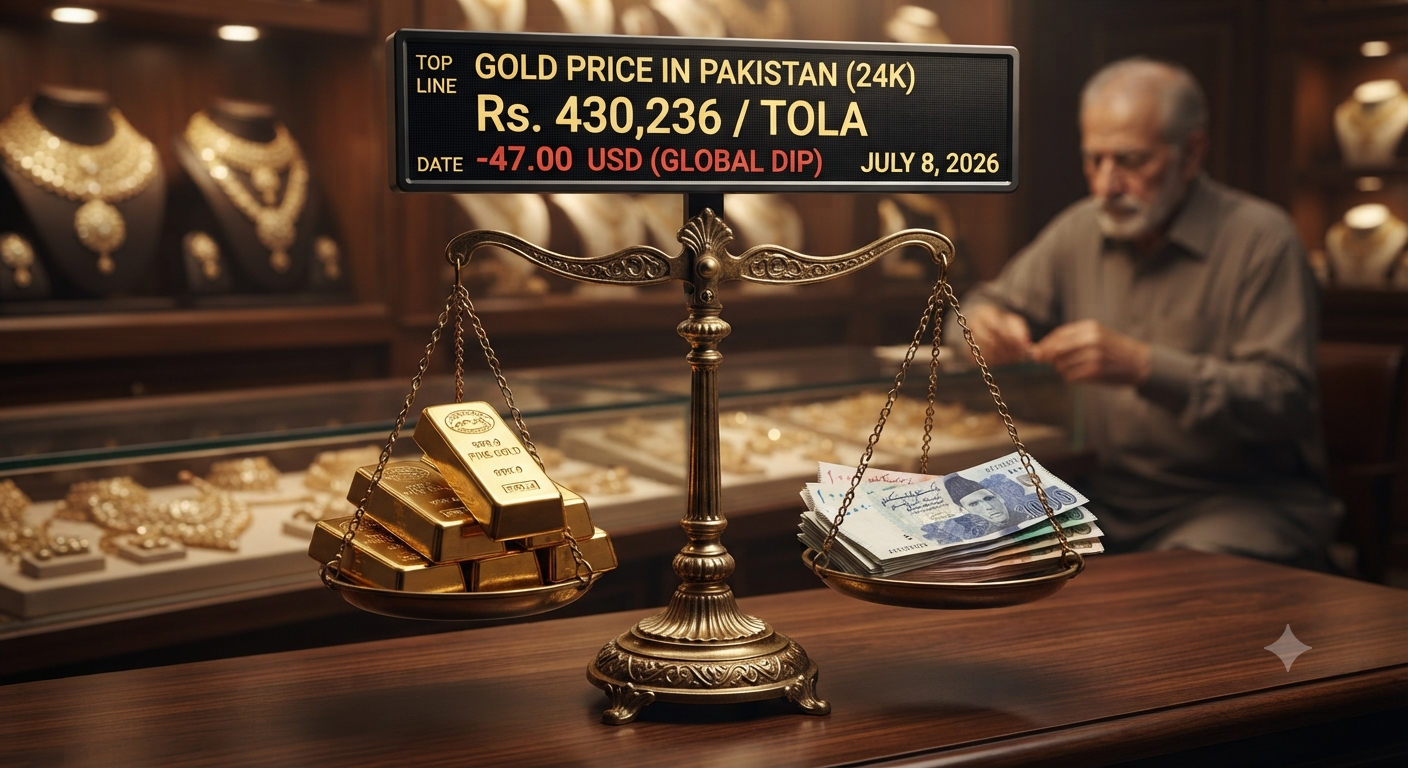
As of Wednesday, July 8, 2026, the market has seen a downward correction for the fourth consecutive day. According to data from the All-Pakistan Gems and Jewellers Sarafa Association (APGJSA), the price of 24K gold per tola has decreased significantly, currently trading around Rs. 430,236.
Why Is the Gold Price Dropping?
You might be wondering why we are seeing this dip despite gold’s reputation as a “safe haven.” The answer lies in the global XAU/USD trend. When international prices slip—as they did by $47 per ounce recently—the domestic market follows suit almost instantly. Local traders and the Sarafa Association monitor these international spot rates to ensure that domestic prices remain aligned with global supply and demand dynamics.
How Global Factors Shape Local Gold Prices
In Pakistan, we are net importers of gold, which makes us highly sensitive to global economic shifts. When the U.S. Dollar strengthens against the Rupee, the cost of importing precious metals rises, often keeping local prices elevated even if international prices are softening.
How Do Interest Rates Influence Gold?
When the U.S. Federal Reserve hints at interest rate hikes, gold often faces pressure. Gold is a non-yielding asset; it doesn’t pay dividends or interest. When government bonds start offering better returns, investors often rotate their capital away from gold, leading to price stabilization or declines.
Is Gold Still a Reliable Hedge Against Inflation?
Historically, yes. In Pakistan, gold has acted as a primary store of value for decades. While the daily price can be volatile, the long-term trajectory over the last five years has been a steady climb. Many families view gold not just as jewelry, but as an essential “rainy day” fund that maintains its purchasing power when currency loses its edge.
Making Smart Decisions in a Fluctuating Market
If you are planning a purchase, the “best” time to buy is often a subject of intense debate among experts. However, seasoned buyers in the local market usually follow a few grounded strategies to avoid overpaying.
Should I Buy Now or Wait?
If you are buying for personal use or as a gift, trying to time the absolute “bottom” of the market is usually a losing game. Instead, look at the trend over several weeks. If the market is experiencing a multi-day decline—like we are seeing right now—it might be a more favorable entry point than during a sharp rally.
Comparing 24K, 22K, and 18K
Not all gold is created equal.
- 24K (99.9% pure): Best for investment purposes, though it is softer and less practical for intricate jewelry.
- 22K/21K: The standard for most jewelry in Pakistan, offering a balance of durability and gold content.
- 18K: Often used for stone-studded jewelry where the metal needs to be hard enough to hold precious stones securely.
Frequently Asked Questions (FAQ)
1. Where can I find the official live gold rate in Pakistan?
The most reliable source is the daily update provided by the All-Pakistan Gems and Jewellers Sarafa Association (APGJSA). You can also check reputable financial tracking websites that aggregate these figures in real-time.
2. Does the price of gold change throughout the day?
Yes. While the APGJSA usually issues a daily rate, sudden global market shifts or rapid changes in the PKR/USD exchange rate can lead to mid-day adjustments by local jewelers.
3. Is there a difference between “per tola” and “per 10 gram” prices?
Yes. A tola is a traditional South Asian unit of measurement equal to approximately 11.66 grams. Prices are often quoted in both units, so always clarify which one your jeweler is using.
4. Why is gold considered a “safe haven” in Pakistan?
Because it is a physical asset that has maintained value across generations, it provides protection against the devaluation of the local currency and periods of political or economic uncertainty.
5. How can I verify the purity of my gold?
Always purchase from reputable, established jewelers and request a hallmarked receipt. Hallmarking is an official certification that confirms the purity and quality of the gold.
6. Does the price of silver follow the same trend as gold?
Generally, yes, as both are precious metals. However, silver is often more volatile and influenced by industrial demand, whereas gold is driven more by investment and jewelry trends.
Disclaimer: This information is for educational purposes only and does not constitute financial advice. Gold prices are subject to change based on market volatility and daily trade updates. Always consult with a trusted local jeweler before making significant investment decisions.