
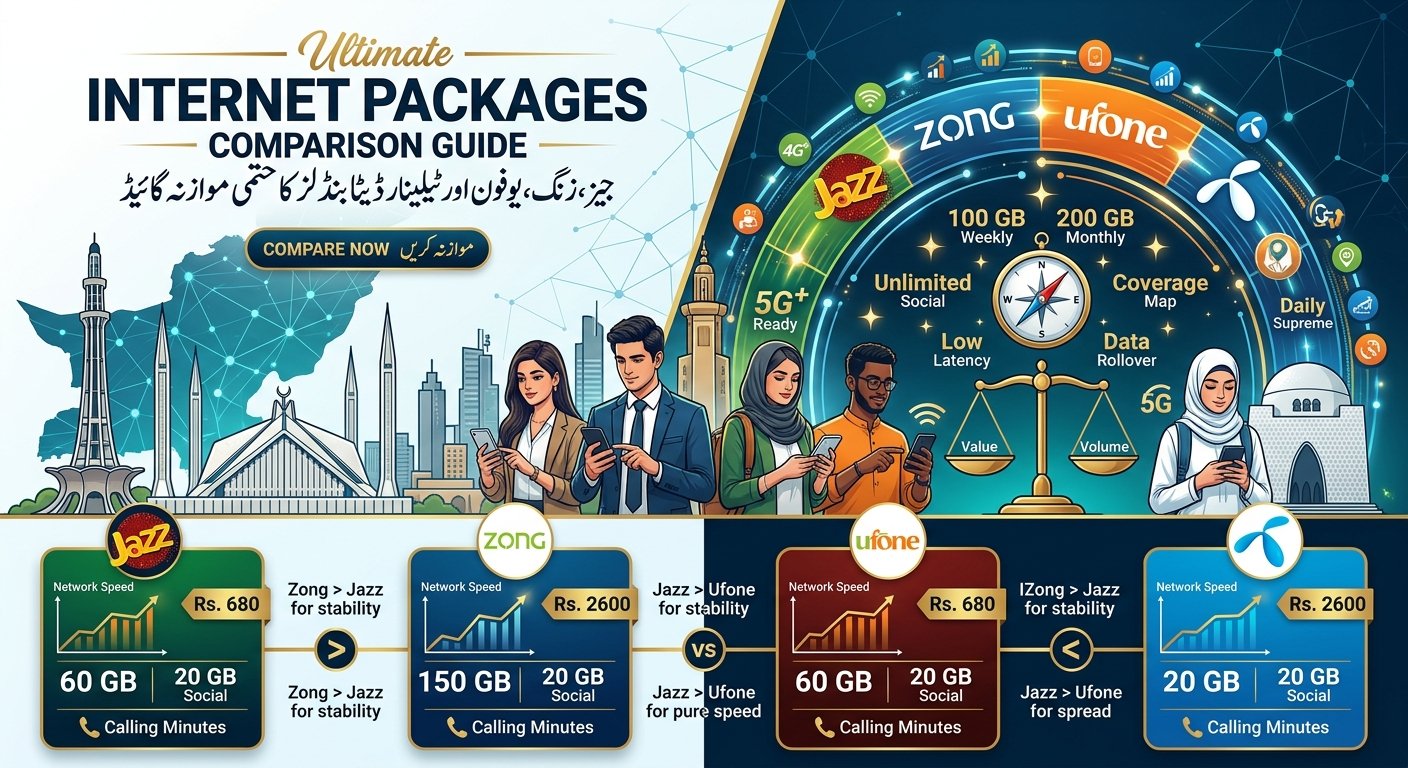
All Network Internet Packages Comparison
Compare all network internet packages side by side. Discover the best daily, weekly, and monthly data bundles from Jazz, Zong, Ufone, and Telenor to maximize your savings. Finding the right mobile data plan feels a bit like trying to find a matching pair of socks in a dark room. Every telecom provider shouts that they have the fastest data, the widest coverage, or the cheapest rates, but the moment you subscribe, you find out half that data is locked behind a “2 AM to 2 PM” restriction. If you are tired of burning through your balance or staring at a buffering screen, you are in the right place. We have cut through the marketing noise to bring you an honest, comprehensive all network internet packages comparison. Whether you need a quick daily fix, a reliable weekly bundle, or heavy-monthly data to power your remote work, this guide stacks up the market leaders side by side so you can choose exactly what fits your budget and lifestyle.
Also read: How to Unblock BISP Account 2026: Block Kafaalat Qist Bahal Karwane Ka Tariqa
Understanding Your Digital Data Needs Before You Pay
Before you type in an activation string, it helps to understand how much data your digital habits actually consume. Most people overpay for giant data buckets they never use, while others get caught short mid-week because they underestimated their streaming habits.
How Much Mobile Data Do You Really Need?
If your daily routine consists of checking WhatsApp messages, reading news articles, and refreshing your email, your data footprint is remarkably light. A modest bundle of 2 GB to 5 GB a month is usually more than enough.
However, everything changes when video enters the frame. Streaming a movie in high definition can eat up to 3 GB of data per hour. If you are an active remote worker joining daily Zoom meetings or a content creator uploading 4K reels on TikTok, your monthly requirements will easily clear the 50 GB mark.
What Are Time-Window Restrictions on Data?
This is the oldest trick in the telecom playbook. A provider might advertise a massive “100 GB Weekly Package,” but a closer look at the terms reveals that 50 GB of that bucket is only usable between midnight and 9 AM. Unless you are a dedicated night owl or running massive automated downloads while you sleep, that extra data is practically useless. Always check the breakdown between “Flat Data” (usable anytime) and “Time-Gated Data.”
Daily Internet Packages: Quick Fixed Data Options
Daily bundles are ideal for emergencies, brief travel days, or when your home Wi-Fi suddenly decides to take a break. They keep you connected without locking you into a long-term financial commitment.
Which Network Wins the Daily Internet Battle?
When analyzing short-term connectivity, the goal is cheap, immediate access. Most carriers offer a mix of pure data buckets and hybrid options that include minutes.
- Zong provides highly competitive daily options, including specialized add-ons like their AI assist bundles and standard 2 GB supreme bundles for around Rs. 120.
- Jazz matches this with punchy daily “Max” offers giving 1 GB of lightning-fast data alongside on-net minutes for short bursts of productivity.
- Ufone relies heavily on targeted daily buckets, such as low-cost unlimited WhatsApp offers (starting at just Rs. 5) and Daily Light packages for basic surfing.
How Do Daily Rates Compare Head-to-Head?
| Network | Package Name | Volume | Validity | Approximate Price (Incl. Tax) |
| Jazz | 3 Day Max (Short term) | 1 GB + 1000 Jazz Mins | 3 Days | Rs. 120 |
| Zong | Daily Supreme | 2 GB + 1000 Zong Mins | 1 Day | Rs. 120 |
| Ufone | Daily Light | 1 GB Flat Data | 1 Day | Rs. 17 |
Weekly Internet Packages: Balancing Price and Volume
For the vast majority of smartphone users, weekly packages are the sweet spot. They offer enough data to get through the work or school week without the higher upfront cost of a 30-day card.
What Are the Top Weekly Bundles Available?
Weekly options have become incredibly competitive, with networks shifting toward massive “Digital Max” and “Freedom” style offerings to win over younger consumers who live on social media.
- Jazz Weekly Freedom / X Plus: Jazz leans into high-volume consumers, offering massive buckets like 50 GB to 100 GB of data (often split with social data allocations) paired with generous off-net and on-net calling minutes, priced between Rs. 670 and Rs. 720.
- Zong Weekly Digital Max / Pro Plus: Zong leverages its robust 4G network architecture to drop heavy weekly bundles. The Pro Plus and Weekly Azadi offers give you 60 GB of crisp data alongside thousands of minutes for roughly Rs. 700.
- Ufone Weekly Mega / Grand Offer: Ufone has drastically ramped up its game, offering an eye-popping 150 GB (100 GB generic + 50 GB social) on its Weekly Mega offer for around Rs. 680, which also includes complimentary access to streaming apps like SHOQ.
Which Weekly Plan Offers the Best Value for Money?
If pure data volume per rupee spent is your metric, Ufone’s Weekly Mega and Jazz’s Weekly X Plus are neck and neck. Ufone gives you raw volume, but Jazz often provides slightly superior edge speeds in crowded urban centers, making it a better fit for mobile gamers who care about lower latency.
Monthly Internet Packages: Long-Term Premium Connectivity
If you prefer a set-it-and-forget-it lifestyle, monthly packages are the ultimate solution. You load your account once at the start of the month and navigate your digital world without counting megabytes every evening.
How Do the Major Monthly Hybrid Cards Stack Up?
Monthly bundles have evolved into full-fledged “Super Cards” or “Pro Max” hybrid plans that bundle data, SMS, off-net minutes, and streaming app subscriptions into a single price tag.
- Zong Monthly Pro Max & Digital Max Plus: Positioned at the premium end of the market, Zong’s flagship monthly packages deliver up to 200 GB of total internet volume alongside 20,000 Zong minutes and 2,000 off-net minutes, sitting at a consumer price point of Rs. 2,600 to Rs. 2,700.
- Ufone Digital Plus & Super Card Gold: Ufone offers high-tier peace of mind with options like the Digital Plus package, giving you 200 GB of massive internet storage, international dialing minutes, and dedicated roaming buckets for Rs. 2,500. Their Super Card Gold offers 80 GB of well-rounded data for Rs. 2,100.
- Jazz Premium Plus & Super Cards: Jazz provides tiered options starting from their basic monthly super cards up to Premium Plus tiers offering 25 GB to 100 GB+ allocations, optimized heavily for consistent data throughput across both urban and rural centers.
Which Network Dominates Monthly Data Allowances?
For heavy data consumers, Zong’s Monthly Pro Max and Ufone’s Digital Plus currently dominate the landscape by offering true 200 GB limits. This eliminates the anxiety of data caps, making them perfect substitutes for home broadband if you live in a location where fiber lines haven’t been laid down yet.
Choosing the Right Network Based on Real-World Performance
Choosing an internet plan solely based on price tables is a recipe for heartbreak. The cheapest package in the world is completely useless if your phone constantly displays an “E” instead of a solid “4G” or “5G” icon in your bedroom.
Why Infrastructure and Location Trump Listed Pricing
Mobile data travels through radio waves from towers. Factors like building materials, population density, and network backhaul dictate your actual speed.
- Jazz has consistently won industry benchmarks (like Ookla Speedtest awards) for pure mobile download speeds, backed by advanced LTE-A deployment.
- Zong provides an exceptionally stable data network, particularly praised for its consistent upload speeds, which are crucial for video calls and online gaming.
- Telenor stands out for its geographical reach, often maintaining stable connectivity in remote northern areas and rural belts where other networks fade.
- Ufone utilizes shared synergies with PTCL’s massive backbone, offering great value and strong urban coverage.
How to Test Network Speeds Before Committing
Expert Content Strategy Tip: Never buy a monthly premium card on a new network right away. Spend a few hundred rupees on a cheap daily or weekly trial SIM. Run a simple speed test at different times of the day—specifically during peak hours (8 PM to 11 PM)—to see if the network chokes under neighborhood congestion.
Frequently Asked Questions
Which mobile network has the cheapest weekly internet package?
Ufone and Telenor generally offer the most budget-friendly entry-level weekly cards (around Rs. 300–Rs. 350 for basic hybrid allowances). However, for heavy data, Ufone’s Weekly Mega gives the highest data volume (150 GB) for its price bracket.
Can I use mobile internet packages on a Wi-Fi device or MiFi cloud?
Yes. Most networks offer specialized “Data SIMs” or “MBB (Mobile Broadband) Bundles” specifically tailored for corporate pocket routers and wingles. Standard smartphone SIM packages may work in devices, but dedicated MBB plans offer much larger volume tiers (e.g., 300 GB+) at optimized price points.
What is the difference between social data and flat data?
Social data is strictly restricted to apps specified by the carrier, typically WhatsApp, Facebook, YouTube, Instagram, TikTok, and Threads. Flat data (or generic data) can be used for anything, including web browsing, online gaming, app updates, and tethering via a mobile hotspot.
Why does my mobile data drain so quickly even when I’m not using it?
Background app refresh, automated cloud backups (like Google Photos or iCloud), and high-definition video auto-play on social feeds are the usual culprits. Turn off background data usage for non-essential apps in your phone’s settings to preserve your package balance.
Are there any hidden taxes applied when activating internet packages?
The prices listed on network apps (like My Zong, Jazz World, or My Ufone) are usually the consumer retail price inclusive of taxes. However, when you scratch a physical load card, the government’s Advance Income Tax (AIT) and General Sales Tax (ST) are deducted from your core balance, meaning a Rs. 1000 load won’t give you exactly Rs. 1000 worth of package buying power. It’s always safest to recharge directly via digital wallets like Easypaisa or JazzCash to see the exact required amount.
Conclusion
There is no singular “perfect” data plan; there is only the plan that aligns perfectly with your location and your usage style. If you are chasing raw speed and snappy performance for gaming or streaming, Jazz and Zong remain the market heavyweights. If you want massive amounts of gigabytes to download large files without draining your wallet, Ufone’s heavy digital bundles offer unmatched value.
Take a moment to look at your smartphone’s built-in data tracker, pinpoint your weekly consumption, check your local signal strength, and pick the plan that keeps you smoothly connected without overpaying.