8171 New Registration Process
Getting your family registered for government financial assistance shouldn’t feel like guessing a password. If you have tried to figure out the 8171 new registration process recently, you have likely run into expired links, confusing instructions, or conflicting updates about the Benazir Income Support Programme (BISP) and Ehsaas initiatives. The process has moved toward a highly secure, biometric-first model managed through local Tehsil offices and verified by the 8171 web portal. This guide breaks down the updated registration system step-by-step so you can secure your family’s eligibility without the typical bureaucratic headaches.
Understanding the 8171 Welfare Infrastructure
Before filling out forms, it helps to understand what happens behind the scenes. The 8171 platform serves as the central administrative gateway for Pakistan’s largest social safety nets, primarily the Benazir Income Support Programme (BISP) and the associated Kafalat updates. It is a data-driven system built to identify households facing genuine financial vulnerability.
What is the 8171 Web Portal?
The 8171 web portal is an online database connected directly to the National Database and Registration Authority (NADRA). It acts as a digital ledger where citizens check their socioeconomic eligibility using their 13-digit Computerized National Identity Card (CNIC) number.
The portal does not just tell you if you are accepted; it provides real-time status updates on whether your dynamic survey is complete, if your payment is ready for biometric withdrawal, or if your account requires re-verification due to an expired CNIC.
How Does the Poverty Score (PMT) Filter Applicants?
Every household registered via 8171 receives a Proxy Means Test (PMT) score ranging from 0 to 100. This score is calculated using an algorithmic framework that weighs assets, household size, utility bill averages, and structural living conditions.
To qualify for the standard core quarterly stipends, your household’s PMT score must fall below a specific threshold—historically set below 32, though specific initiatives like the Punjab Himmat Card extend eligibility up to a PMT score of 45 for persons with disabilities. The lower your score, the higher your priority in the system.
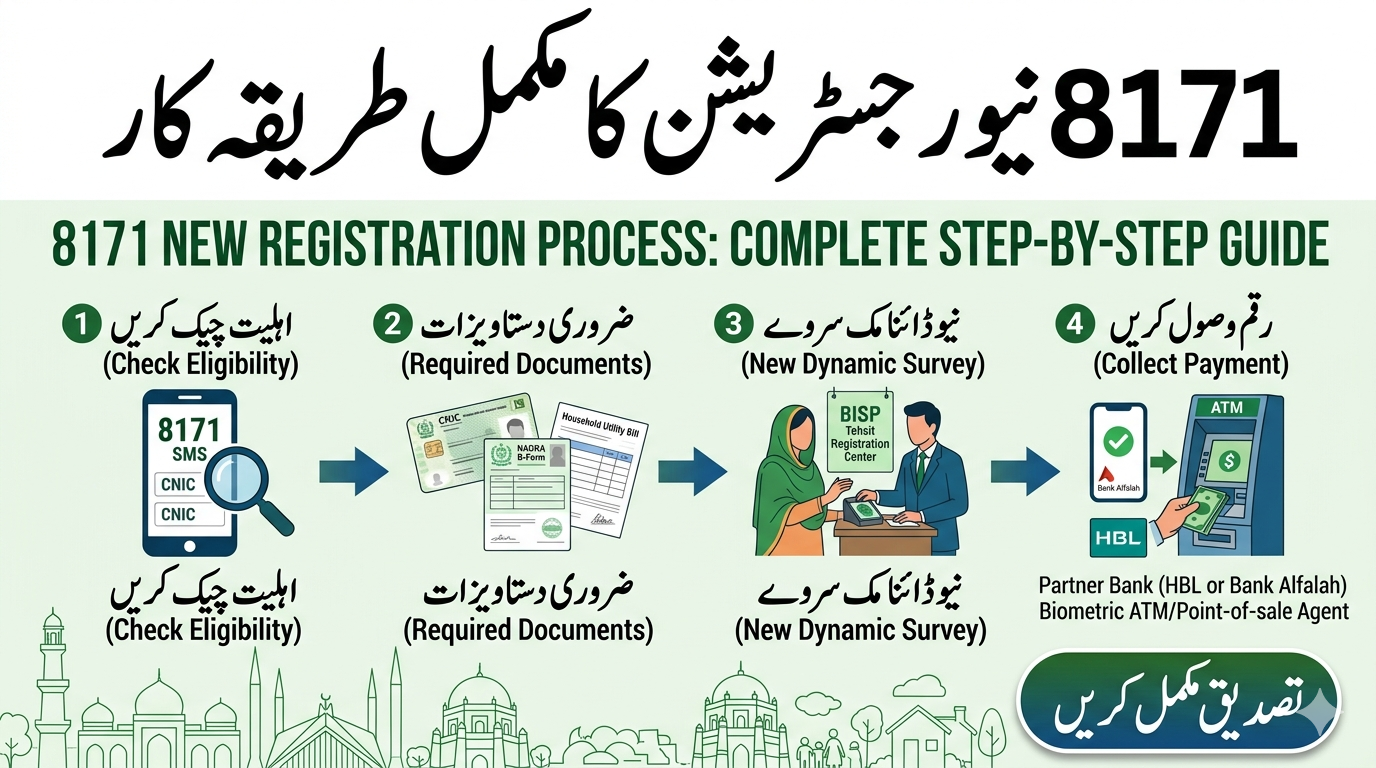
Phase 1: Checking Initial Eligibility via 8171 Web Portal
Do not rush to a registration center without checking your baseline status first. You can verify your family’s standing right from your mobile phone, saving you hours of waiting in lines.
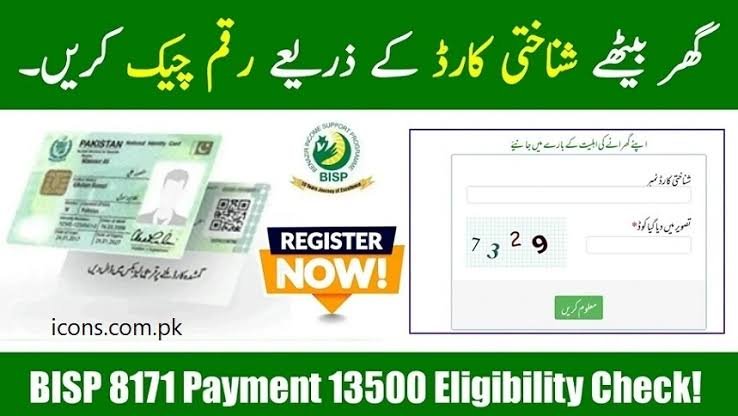
Online CNIC Verification Method
The easiest way to check your registration status is through the official online interface.
- Open your web browser and navigate to the official 8171 Web Portal.
- Enter your 13-digit CNIC number without any dashes or spaces into the designated field.
- Input the 4-digit security captcha code displayed in the image on the screen to prove you are not an automated script.
- Click the “Track” or “Check Status” button.
The portal will instantly display your status, indicating whether your family is eligible, if you need to undergo a new dynamic survey, or if an installment has been dispatched to your designated biometric bank branch.
SMS Verification Route
If you lack reliable internet access, the SMS route offers a direct line to the database.
- Open your mobile messaging app.
- Type your 13-digit CNIC number clearly into the message body.
- Send the text message to the shortcode 8171.
Within a few minutes, you will receive an official system response detailing your household’s current eligibility phase. Note that standard mobile network carrier charges apply to this text message.
How do I check my 8171 eligibility online?
Many applicants ask this when they encounter third-party scam apps. The only secure method is using the official government 8171 portal link. Avoid entering your personal identity details on unofficial blogs or unverified mobile applications, as these are frequently used to harvest CNIC data illicitly.
Phase 2: Gathering the Required Documentation
A major reason applications get flagged or delayed is missing paperwork. The dynamic registry system relies heavily on matching records across multiple state databases.
Essential Paperwork Checklist
Before heading out to a physical center, ensure you have gathered the following original documents:
- Original valid CNIC: The primary applicant’s card must not be physically damaged or expired.
- NADRA B-Form (Child Registration Certificate): Required for every child in the household if you plan to enroll them in the Taleemi Wazaif educational stipend program.
- Recent Household Utility Bills: Bring your latest electricity or gas bill to verify your residential address and energy consumption tier.
- Disability or Widowhood Certificates: If applicable, an official union council death certificate for a deceased spouse or a Social Welfare Department disability certificate to qualify for specialized sub-programs.
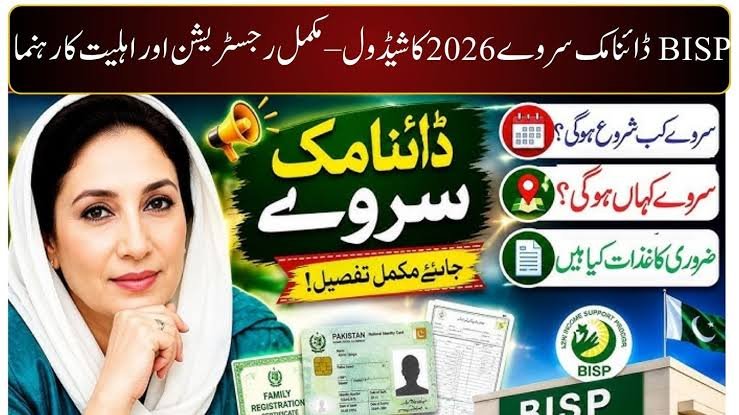
Phase 3: Navigating the BISP Dynamic Survey Registration
The core of the new registration process relies on the Dynamic Survey. Static data sheets are no longer used; the government now uses a living registry that updates as your family’s economic status changes.
1.Visit the Nearest Tehsil Registration Office:
Step 1: On-Site Arrival.
Locate your local BISP Tehsil Center. It is highly recommended to arrive early during weekday business hours. Ensure the primary female head of the household is present, as the program prioritizes female-led family structures for distribution.
2.Obtain a Token and Proceed to the Data Counter:
Step 2: Token Issuance.
Present your original CNIC at the reception desk to secure a processing token. Once your number is called, advance to the data entry terminal where a designated desk officer will open a new dynamic registry case file.
3.Complete the Socioeconomic Interview:
Step 3: Socioeconomic Profiling.
Answer the officer’s interview questions accurately. You will be asked about your monthly household income, the number of dependent children, structural conditions of your home, ownership of livestock, and your monthly utility usage. This data directly calculates your PMT score.
4.Provide Biometric Verification:
Step 4: Biometric Authentication.
Place your thumb on the biometric scanner connected to the NADRA database. This step locks your application to your identity, preventing identity theft and ensuring that future monetary transfers can only be claimed by you personally.
Critical Note on Fees: The dynamic survey and entire registration process are entirely free of charge. No government official or desk operator is authorized to collect fees for processing your application. If anyone demands payment to lower your PMT score or speed up your verification, report them immediately to the official helpline.
Phase 4: Tracking Your Application and Resolving Disqualifications
Completing the survey does not mean money appears instantly. Your file enters a rigorous cross-verification cycle across multiple government databases to ensure complete data integrity.
Post-Survey Verification Timeline
Once submitted, your data undergoes digital cross-matching. The system checks your CNIC against passport databases, vehicle registries, and executive bank accounts to ensure the reported income matches reality. This background review process typically takes anywhere from 4 to 8 weeks. You can check your progress weekly via the 8171 portal.
Understanding Status Messages and Rejections
When tracking your application, you may encounter specific status messages:
| Portal Status Message | System Meaning | Required Action |
| Record Not Found | Survey has not been conducted yet | Visit the nearest Tehsil office to register |
| In Process | Background verification ongoing | Wait for the verification timeline to complete |
| Eligible | Approval confirmed | Proceed to claim the quarterly disbursement |
What does it mean if my 8171 status says ‘Ineligible’?
This occurs if your cross-referenced data reveals factors that push your household above the poverty threshold. Common reasons for automatic disqualification include owning registered agricultural land, a member of the household holding a government job, recent international travel history, or owning a registered commercial vehicle.
If your financial situation deteriorates after a rejection, you have the right to request a re-survey after a mandatory cooling-off period of six months.
Phase 5: Collecting Payments Securely
Once your portal status changes to a successful approval notification, you can access your funds through the official biometric disbursement network.
Biometric Retail Outlets and Partner Banks
Payments are distributed via biometric verification at designated commercial bank touchpoints, depending on your geographic region. In Punjab, Sindh, and Islamabad, distributions are typically handled via Bank Alfalah clusters, while Habib Bank Limited (HBL) services Balochistan, Khyber Pakhtunkhwa, and Azad Jammu & Kashmir. You can collect your cash from authorized biometric ATMs or designated retail partner point-of-sale (POS) agents.
Biometric Cash Withdrawal Steps
- Locate an authorized HBL or Bank Alfalah POS agent or retail shop terminal.
- Select the “BISP” or “Ehsaas” option displayed on the device touchscreen menu.
- Enter your 13-digit identity card number carefully into the numerical pad.
- Place your registered right thumb firmly onto the connected biometric scanner.
- Verify the full payment amount shown on the screen and collect your physical cash.
Always request a printed receipt from the retailer upon completion, and ensure you count your cash before leaving the counter to protect yourself against unauthorized deductions.
Frequently Asked Questions
How long does it take to get money after 8171 registration?
After successfully completing the dynamic survey at a Tehsil center, the backend verification phase generally requires 60 to 90 days. Once your data successfully satisfies all systemic filters, your cash release order is scheduled within the next upcoming quarterly payment cycle.
Can a family register if the husband is a government employee?
No. The system filters out any household where an immediate family member listed on the NADRA family tree is an active or retired government employee drawing a state salary or pension, as these families fall outside the targeted low-income mandate.
What should I do if my fingerprints do not match the biometric scanner?
If your fingerprints fail to register due to age or manual labor wear, visit your local NADRA office for a verification refresh. If problems persist, file a formal biometric failure complaint at your regional BISP office to transition your account to a double-verification bypass protocol.
Are there separate registration tracks for the Taleemi Wazaif program?
Yes, but completing the primary 8171 dynamic survey is a prerequisite. Once the mother is registered and approved for the Kafalat core program, you can enroll your children by bringing their NADRA B-Form and an official school attendance verification sheet to the center.
What happens if my CNIC expires after my registration is approved?
Your payments will be frozen automatically by the banking system for security. You must renew your identity card at a NADRA center and complete a fresh biometric verification update at your nearest partner bank agent branch to resume your disbursements.
Action Plan for Applicants
To make sure your registration goes smoothly without unexpected delays, keep these final tips in mind:
- Audit Your Identity Status: Check that your mobile SIM card is registered under the exact same CNIC number you are using for the application. Mixed records can trigger system flags.
- Keep Your Contact Info Updated: If you change your phone number, visit your local Tehsil office to update your record. The 8171 system sends critical payment alerts exclusively via SMS.
- Monitor the Official Channels: Always rely directly on the official 8171 web portal for verification. Never share your security codes or identity card copies with unverified agents.