
Punjab Solar Scheme Registration
Managing an ancestral home or property in Punjab from thousands of miles away comes with plenty of moving parts—especially when skyrocketing utility bills catch your eye. While the CM Punjab Solar Scheme (Roshan Gharana) promises free or subsidized solar setups, navigating registration from abroad with a NICOP raises real questions. Let’s break down how diaspora property owners can approach this initiative strategically.
Also read: Interest-Free Loans and Small Business Grants: How to Apply Online
Understanding the Roshan Gharana Framework for Property Owners
Before diving into digital application workflows, it helps to understand what the Roshan Gharana initiative actually entails. Rolled out under the leadership of Punjab Chief Minister Maryam Nawaz, this multi-phased project targets domestic electricity consumers by providing solar kit tiers based on monthly consumption brackets.
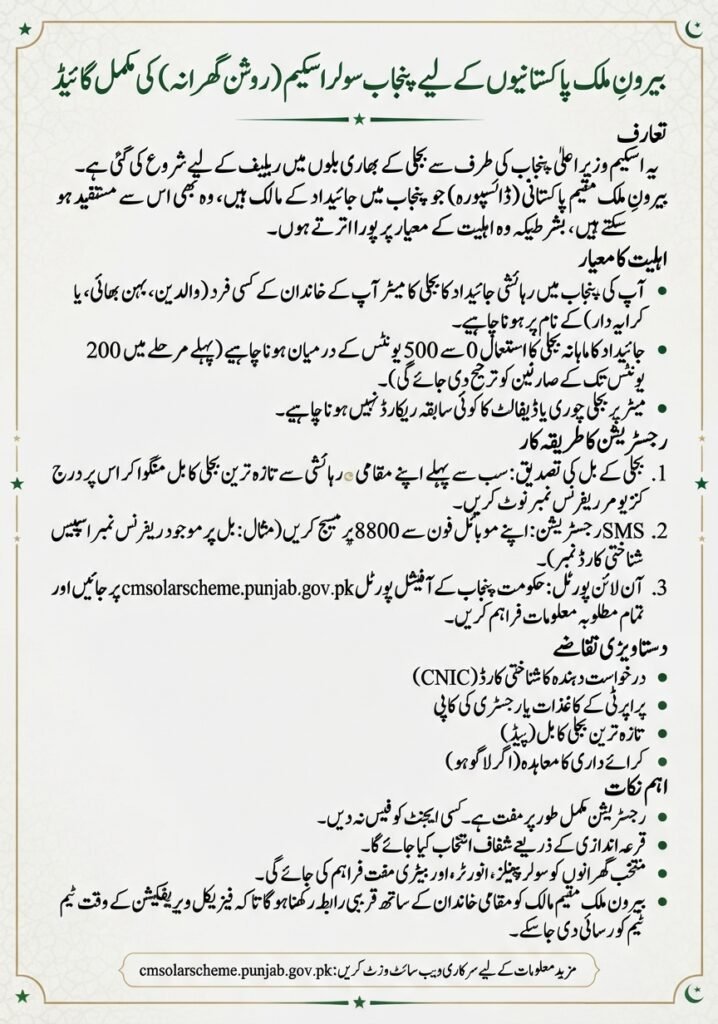
The core eligibility architecture centers heavily on local utility footprints rather than your passport status. The government relies on distinct parameters to filter applicants:
- The DISCO Connection: The property must have an active residential electricity meter linked to a provincial distribution company like LESCO, MEPCO, FESCO, GEPCO, or PESCO.
- Consumption Brackets: Priority heavily favors low-tier users consuming between 0 to 200 units monthly, scaling up incrementally for higher brackets.
- Clean Utility Record: The utility account must have zero history of meter tampering, defaulted payments, or electricity theft.
As an overseas Pakistani, your name might not be the primary name on the electricity bill if the property is occupied by extended family, tenants, or caretakers. This brings up an immediate structural hurdle that catches many diaspora applicants off guard.
Can Overseas Pakistanis Directly Register for the Punjab Solar Scheme?
This is where expectations need a reality check. The Punjab solar scheme is fundamentally designed as a social welfare relief measure for resident domestic consumers experiencing immediate domestic financial strain from local utility bills.
The system is not an open investment scheme or a commercial diaspora bond. Therefore, you cannot simply log in using an overseas IP address, punch in a foreign phone number, and claim a free solar kit for a vacant plot or an empty investment property.
However, if you own a home in Punjab where your elderly parents, siblings, or authorized tenants currently reside, your property can still qualify—provided the application is executed correctly through local parameters.
Expert Insight: Think of the solar scheme as tied to the meter, not the owner’s physical presence. If the electricity bill is registered under a family member’s name residing at that Punjab address, they can apply, but you as the diaspora owner must coordinate the underlying documentary compliance.
Step-by-Step Practical Approach for Properties Managed from Abroad
If you want to ensure your family home back in Punjab successfully participates in the computerized balloting rounds without running into administrative rejections, a structured coordination plan is essential.
Step 1: Audit the Electricity Bill and Sanctioned Load
Before initiating any digital steps, ask your family or tenant in Punjab to send a snapshot of the most recent monthly electricity bill. Verify two critical metrics:
- Sanctioned Load: Must ideally remain under 2 kW for baseline eligibility tiers.
- Unit Consumption: Ensure average monthly consumption falls within the targeted threshold (typically 0–200 units for fully subsidized tiers). If your rental property or family home runs multiple heavy air conditioners, pushing usage past 300 or 500 units, the automated verification portal will instantly flag and reject the application.
Step 2: Clear Up Title and Billing Discrepancies
Many overseas Pakistanis keep utility bills under the name of a deceased grandparent or an uncle who migrated decades ago. Government database cross-checks rely heavily on matching Computerized National Identity Card (CNIC) records with DISCO billing databases. Ensure the billing name aligns with an active resident occupant or that proper NOCs and ownership papers are readily available for physical verification teams.
Step 3: Execute the Portal Submission or SMS Verification
Applications are processed via the official government portal (cmsolarscheme.punjab.gov.pk) or through the designated shortcode (8800).
- Coordinate with the resident family member to submit the consumer reference number alongside their valid Punjab-address CNIC.
- Avoid third-party agents or overseas consultants claiming they can bypass the queue for a fee. The entire selection occurs strictly via transparent computerized balloting.
What Are the Verification Hurdles Unique to Diaspora-Owned Homes?
Managing applications remotely exposes you to specific operational bottlenecks. When the government validation teams or DISCO field representatives conduct random physical audits of shortlisted properties, certain red flags can derail the process:
- Locked Premises: If your property is locked because your family is traveling or the house is temporarily vacant while you look for new tenants, field inspectors cannot verify roof space or active meter load.
- Tenant-Landlord Communication Gaps: If a tenant applies without informing you, or if you apply without notifying the tenant who pays the bill, confusion over physical site inspection appointments can lead to missed verification windows.
- Mismatched Mobile Numbers: The SMS alerts and tracking IDs go exclusively to the mobile number registered against the local CNIC. Ensure your local family member maintains active control of that specific SIM card.
How Does Computerized Balloting Affect Your Chances?
Because high demand vastly outweighs available state inventory, the Punjab government utilizes a random computerized ballot to select beneficiaries.
| Selection Phase | Allocation Criteria | Diaspora Implications |
| Phase 1 (Low Usage) | 0–100 units (550W system) | Ideal for smaller ancestral quarters or village homes. |
| Phase 2 (Standard Usage) | 101–200 units (1,100W system) | Common for standard urban residential units. |
| Subsequent Rounds | Scaled hybrid frameworks | Subject to phased budgetary expansion. |
Being eligible does not guarantee immediate installation in the first ballot draw. If your application enters the pool, it remains eligible for subsequent phases, provided consumption patterns do not spike past threshold limits.
People Also Ask (H3 Subheadings)
Can overseas Pakistanis apply using their NICOP?
The primary application requirement demands a valid CNIC with a permanent address located within Punjab province, coupled with an active local utility meter. A standard NICOP held by an overseas resident living abroad cannot directly replace a local residential utility consumer profile unless an eligible resident family member occupies and manages the metered premises under local documentation.
What happens if the electricity bill is not in the occupant’s name?
If the bill is under a previous owner’s or relative’s name, verification filters may flag the entry during automated DISCO cross-checks. It is strongly advised to update the consumer name legally through your local DISCO office or ensure that valid proof of residence and ownership documentation can satisfy physical inspection teams.
Are rental properties owned by overseas Pakistanis eligible?
Yes, rental homes can qualify provided the monthly unit consumption falls within the mandated low-tier bracket and the tenant possesses explicit landlord authorization (NOC) alongside a clean utility payment history. However, landlords must coordinate closely with tenants to ensure field verification appointments are met.
How can I check the application status from abroad?
You can monitor the progress remotely by having your local family member input the tracking ID or applicant CNIC into the official portal (cmsolarscheme.punjab.gov.pk). Official status updates and ballot announcements are also communicated via SMS to the primary mobile number tied to the submission.
Can I pay a private fee to secure early installation?
No. The government explicitly warns that all official registrations via 8800 or the web portal are entirely free, and beneficiaries are selected solely through transparent computerized balloting. Anyone claiming to expedite your panel allocation for cash is operating an unauthorized scam.
Conclusion
Managing property back in Punjab from across international borders requires a balance of digital vigilance and local coordination. While the CM Punjab Solar Scheme is tailored primarily for resident domestic consumers rather than direct remote application by overseas passport holders, your family homes and rental properties can still reap the benefits of this green energy transition. By auditing your utility consumption, ensuring clean billing titles, and guiding your local representatives through official channels like cmsolarscheme.punjab.gov.pk, you can successfully lower household overheads and secure a sustainable future for your property back home.
Frequently Asked Questions
- Is there any registration fee for the Punjab solar scheme?
No, official registration via SMS (8800) or the government web portal is 100% free of cost. - What system sizes are distributed under the scheme?
Kits typically range from a single 550W panel to 1,100W systems (1.1 kW) depending strictly on your verified monthly consumption bracket. - Can commercial properties owned by overseas investors apply?
No, the Roshan Gharana initiative is strictly restricted to residential domestic electricity consumers. - What is the official website for checking updates?
All authentic updates, portal links, and status trackers are hosted exclusively on cmsolarscheme.punjab.gov.pk. - What causes an application to get rejected automatically?
Common triggers include monthly power usage exceeding 200 units, a sanctioned load higher than 2 kW, duplicate CNIC entries, or a history of meter tampering. - Do I need a battery backup included with my scheme kit?
Lower baseline tiers provide basic off-grid inverter and panel configurations designed primarily for daytime solar offset rather than full independent storage.